- Noah Jacobs Blog
- Posts
- On FOMO

2026.01.18
CXXXV
[Doxycycline; Not Financial Advice; Chad the Bootstrapper; Brad the Fundraiser; Cats in the Cradle; Electrolytes]
Thesis: FOMO is a weapon that needs to be aimed in the right direction. Also, don’t lie down after taking Doxycycline on an empty stomach.
[Doxycycline]
A lot of people ask me how I’ve been able to commit to writing a weekly blog without fail for over two years. I'll usually respond with something like "I just don't negotiate with myself about it. I do it"
Then, they press, as if it can't be that simple, as if there is something about this behavior of mine that makes me qualitatively different than them.
After that, I get confused--am I wrong? Is there something qualitatively different about me or my behavior?
Then, a day like today happens where I feel like absolute shit & still write the blog anyway, and I’m reminded that it really is just about doing the thing, even when you don’t feel like it.
For some background, about 8 days ago, it was discovered that I have an ear infection. In response, a good German doctor in Tampa, Florida, gave me Doxycycline.
I started taking it, and everything was fine. But, when I got to Atlanta with Jack, prior to taking the last two nights of the dose I entirely forgot the very clear rules of not laying down after you take it. So, last night, after my very last dose, I lied down and went to sleep.
I slept terribly. I woke up to hot flashes, nausea, etc. At first, I thought I was sick again, was wondering if it was the sushi I had two nights ago.
As night became morning, and I became more coherent, like a child forgetting the very clear rules around caring for his Gremlins, I realized I had simply neglected the rules around these pills. Now, my mother, as she's reading this, is kicking herself, "I told him not to lie down!" To make matters worse, mom, I took the pill a couple of hours after eating the last two nights, another violation of the rules. It's not your fault, it's mine.
Either way, I woke up this morning 30 minutes before my alarm and did terrible things to Jack's toilet, and then proceeded to go for a walk in shorts in the 20 something degree Atlanta morning weather.
And now, here we are, writing this blog before 7 am on a Sunday at a standing desk when really I want to curl up and die. I'm still running to the bathroom about every 30 minutes.
I pray that by the time I'm done writing, this evil has fully passed me.
The point of this rant? To reaffirm my answer with a little bit of color: I can commit to something like writing a blog every Sunday for years because I’m not negotiating about it, even when I feel terrible. It’s not glamorous, but it’s real. If you want to do the thing, you just do the thing.
Anyways, today we’re talking about the weapon known as Fear of Missing Out (FOMO) as it relates shill financial advisors, Brad the Fundraiser, and my own startup.
[Not Financial Advice]
I broke protocol this week and called a financial advisor unethical on LinkedIn.
If you're new here, I hate social media, but I derive the vast majority of my income from marketing on LinkedIn. Really, it's my co founder that drives most of our traffic, but there is still a clear line between my activity and money: as an example, someone commented on my post in mid-late December asking for a demo, I responded within an hour, we had a call the next day, and the proposal just got signed last week.
So, it’s not cope, I really do have at least some business related pretense to go on LinkedIn.
Anyways, I got recommended this heinous post from a financial advisor, which I refuse to link here now to prevent the shill from getting any more traffic. We'll just call the guy who posted it Jim. To paraphrase it, Jim basically said:
Dave Ramsey said online gambling is a portal to hell. Ironic, coming from a guy who made a fortune giving people financial advice that holds them back.
I was having a hard time understanding why Jim would dunk on Ramsey for dunking on online gambling… online gambling is obviously a terrible financial decision. And, if it's not obviously a terrible financial decision to some people, then it's super good that Dave Ramsey is saying that it is, so maybe they'll see it.
Either way, I am rage baited by the rage bait and engage with Jim, saying yes online gambling is bad and saying Dave Ramsey's advice is generally good.
Jim goes on to argue that by paying down debt before investing in the market, you're "missing out" on compound interest.
I waste braincells explaining to Jim that the only way his argument works is if his clients are willing to take on additional risk, which he “disagrees” with. I can get why someone who’s not a finance bro might fall for this sleight of hand, but Jim should know better, seeing as he has every finra license under the sun.
When you calculate your net worth, you take assets minus liabilities. If you have debt carrying 6% interest, this is a liability that itself experiences compound interest, just against you. So, quite logically, if you are trying to maximize net worth, you would want to pay down the 6% debt. This is a 6% risk free return; to put it in a frame of reference, the risk free rate available to the average Joe isn’t even above 4%.
And you might say, Noah, but if I invest in the market, I can return 8%, or maybe 20%, or 100%! And yes, as Jim kindly pointed out: you can.
But what Jim would NOT admit in the LinkedIn comment section was that by investing in the market, you're also taking on WAY more risk. Paying down debt is literally "risk free", meaning you will get the 6% return. Investing in the market could cause you to make money OR lose money in a given year. And, if you can otherwise pay down your debt in a few years, delaying that by investing in the market could lead to a worse outcome.
Jim, though, wouldn’t admit this. He was claiming that not investing in the market was a bigger risk than in effect, getting a 6% risk free return. This is a classic example of someone selling on fear of missing out (FOMO): “If you don’t do this thing I’m recommending, you’ll be sooo behind and regret it.”
And why would Jim market this?
Well, every dollar Jim gets his victims to put into the market rather than to pay down debt is one more dollar Jim gets to take a fee on, personally enriching himself while putting his clients at risk. All the while, he’s telling them that the “bigger risk” is to not take risk.
To be clear, I’m not anti debt, there are cases in which carrying debt makes sense. But, it adds risk, which is something that Jim is clearly hiding.
I said what I meant and I meant what I said: Jim is unethical.
[Chad the Bootstrapper]
I listened to two calls that my co founder Jack had this week.
The first was with a very cool guy who bootstrapped two companies, one to about $25M in rev, the other to about $6.5M in revenue, both of which he still owns. We'll call this guy Chad.
Now Chad told Jack about how sometimes he would talk to his competitors who have raised money (Chad did not), have 70 employees (Chad has less than 10), and have maybe a little more revenue than Chad’s $6.5M business, say $8M. They'll ask Chad for advice, and then they'll say something like, "Chad, I can't take that advice. I'm trying to build a BIG business."
They typically have their eyes set on unicorn status and are convinced that it's the only way out. They're trying to build "Generational" businesses with hundreds of millions of dollars in revenue.
Chad, on the other hand, acknowledges that monthly churn for their product category is heinous (9%) and has publicly stated that his business is "un-investable". In other words, unlike the VC backed founders in the space, he doesn't think it makes sense to try to turn the business into a unicorn. He's just trying to get to double or triple his revenue in the next few years:
We are so profitable that the outcome of my personal life is so convex to adding another $5-$10M in revenue.
Chad has a really good point. And, to see it, he had to ignore the FOMO narrative of his VC backed compatriots.
[Brad the Fundraiser]
The second conversation I listened to was with Brad. Brad is a VC backed founder in the same space as us & Chad, but with a different product than either of us.
Unlike Chad, Brad gave Jack a lot of unsolicited advice. Brad spoke with a religious fervor about how great his go to market strategy was and how BirdDog should absolutely copy him to get really incredible asymmetric growth.
The thing is, Brad started at the same time BirdDog did, raised a few million dollars (we raised none), has a team of 9 engineers (we have me), and has less than 10% of the revenue that BirdDog does.
I’m not at all saying that Brad’s advice is wrong, and I’m also not saying that there’s no chance that he won’t lap us in revenue quickly. He could totally be right. But, at the moment, it’s objectively uncertain.
The interesting thing, though, is how he seemed to really be invested in getting Jack to agree with his ideas, while ignoring the material differences in both our inputs and outputs to date.
Chad doesn't care if anyone agrees with him. He also doesn't really care if the VC founders he talks to agree with him. He is personally making more money than the a lot of them combined ever will, and is really just focused on the actions he can take to make sure that stays true.
It's fascinating, because Brad & the founders Chad mentioned all seem to focus more on their ideas than their actions. They tend to be very evangelical and preach a gospel of FOMO—if you don’t do things this way, you’re not going to make it.
Well, we’re going to follow Chad a lot more than we follow Brad.
[Cats in the Cradle]
All this talk about how FOMO can be dangerous, I'm so glad BirdDog NEVER use FOMO ever to market anything...
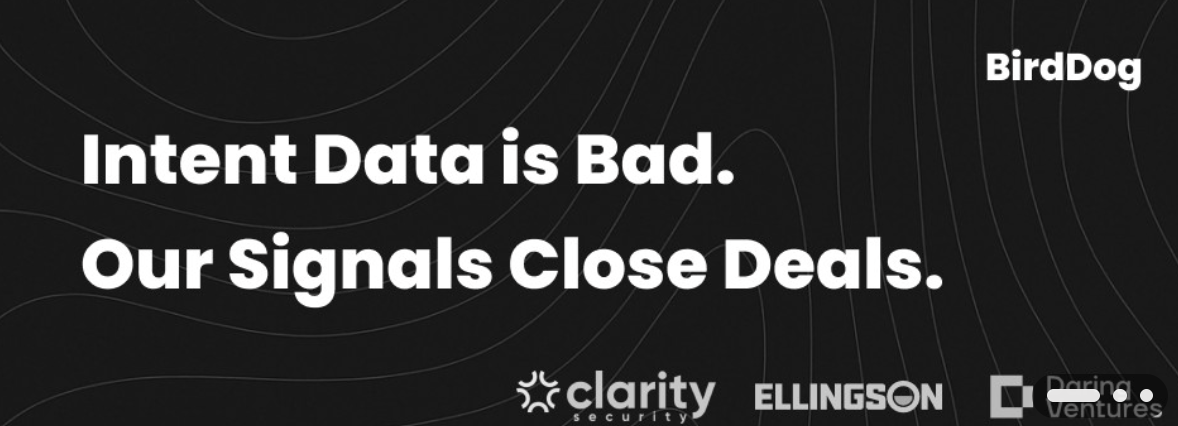
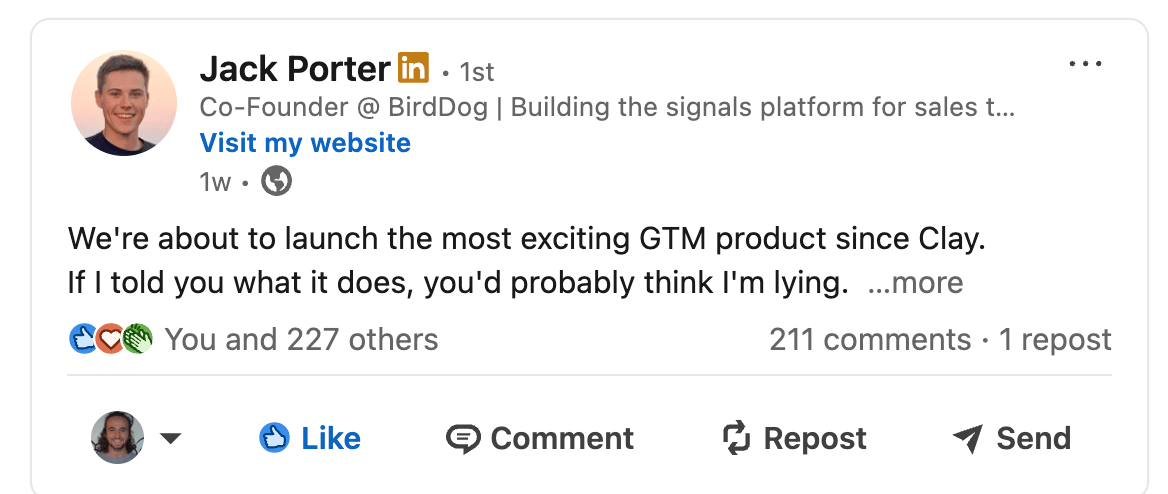
Wait a minute… we totally do! Chad does, too, by the way.
Well, we’re different, because we actually believe what we’re selling will have a very positive ROI for customers. But… Jim the Financial Advisor and Brad... don't they also believe that what they're selling is legit?
So, is there a difference between me, Jim, and Brad? If it’s not belief, what is it?
The only thing I can come up with is whether or not the things we’re saying our actually aligned with reality.
FOMO is a super strong strategy for marketing things... and I'm not really upset when I see something 'good' being marketed with FOMO. As examples, I’m not upset about:
The song Cats in the Cradle using FOMO & irony to market spending time with loved ones
Those billboards that show a family in nature with a quirky one liner like “nature, pass it on”
Karl Popper in the “Open Society & It’s Enemies” stressing that we must fight closed societies that suppress liberty
FOMO is sort of like a gun. You wouldn't be upset about a gun if it was used to stop someone from launching a nuclear warhead on a city. You would be upset, though, if a gun was used to kill the victim of a home invasion.
So, maybe FOMO is like a weapon, a powerful tool for getting people to agree with you.
Even if you see FOMO commonly being used for negative things, like Jim’s marketing, or being used in uncertain things, like Brad’s preaching of his strategy, it doesn't mean that FOMO itself is bad. Because, you can also use FOMO for selling ideas & concepts that are aligned with truth.
Everyday, my goal with BirdDog is to cause it to fall into the latter category.
If you liked this post, please subscribe. I’m here every week, even when I want to throw up.
[Electrolytes]
Since the start of writing this post, my physical condition has improved materially for the better. My stomach is still uncomfortable and I’m somewhat nauseous, but a standing desk, cold walk, and sipping electrolytes really did go a long way.
I don’t think there’s anything wrong with FOMO in itself. Just remember that it’s a tool, and if someone is using it on you, worry more about if the underlying thing they are convincing you of is true and less about the marketing itself.
Live Deeply,